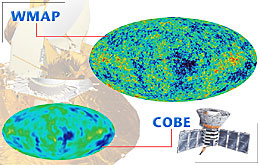
My research focus is on experimental/observational cosmology and instrumentation, including space flight instrumentation.I became the Principal Investigator (P.I.) of the Wilkinson Microwave Anisotropy Probe (WMAP) mission in 1996. WMAP was competitively selected as a NASA medium-class Explorer (MIDEX) mission. WMAP was launched June 2001 and its first scientific results were made public in February 2003. WMAP quantified the age, content, history, and other key properties of the universe with unprecedented accuracy and precision. This was recognized by Science magazine as the 2003 "Breakthrough of the Year." |
|
Previously I was the Deputy P.I. of the Differential Microwave Radiometers (DMR) instrument and a member of the Science Team of the Cosmic Background Explorer (COBE) mission. The COBE Differential Microwave Radiometers instrument was used to make the first detection of variations across the sky (anisotropy) of the temperature of the afterglow radiation from the Big Bang, the cosmic microwave background radiation. I participate in NASA's Legacy Archive for Microwave Background Data Analysis (LAMBDA) data center. LAMBDA provides COBE, WMAP, and other cosmological data to the community. In 2010 I began work on a new experiment, funded by the National Science Foundation (NSF), to quantify the reionization of the universe. Our group is building the Cosmology Large Angular Scale Surveyor (CLASS) to characterize faint polarization patterns across 75% of the sky. CLASS is situated in the Atacama desert in northern Chile. In summary, I helped to determine a Standard Model of Cosmology and I am currently engaged in testing and extending that model, as necessary. |
